You’ve bought the exercise bike. It arrived in a box the size of a wardrobe, you spent forty-five minutes assembling it while questioning your life choices, and now it’s sitting in the spare room looking at you expectantly. You hop on, pedal for ten minutes, get bored, and wonder if you’ve just wasted two hundred quid. Sound familiar?
The problem isn’t the bike — it’s that nobody told you what to actually do on it. “Just pedal” is about as useful as telling someone who’s never cooked to “just make dinner.” You need structure, progression, and enough variety to stop you reaching for your phone every three minutes. That’s what this guide delivers: real exercise bike workouts for beginners that actually work, build fitness progressively, and — most importantly — don’t make you dread getting on the saddle. For related guidance, see our Rowing Machine vs Exercise Bike: Which Burns More Calories? guide.
I’ve been using exercise bikes in home gyms for over three years now, testing everything from budget exercise bikes under £200 to high-end spin bikes. These workouts are the ones I keep coming back to, and the ones I recommend to friends who are just starting out. For related guidance, see our Peloton vs Echelon vs Wattbike: Indoor Bike Showdown guide.
In This Article
- Before You Start: Setting Up Your Bike Properly
- Understanding Resistance and Intensity
- Workout 1: The 20-Minute Steady State Ride
- Workout 2: The Interval Builder
- Workout 3: The Pyramid Climb
- Workout 4: The Endurance Builder
- Workout 5: The Tabata Sprint
- How to Build a Weekly Exercise Bike Plan
- Common Mistakes Beginners Make on Exercise Bikes
- Tracking Your Progress
- When to Move Beyond Beginner Workouts
- Frequently Asked Questions
Before You Start: Setting Up Your Bike Properly
A badly set-up bike will give you knee pain, back ache, and a sore backside — none of which are motivating. Take five minutes to get this right and everything else becomes easier.
Seat Height
Stand next to the bike. The seat should be roughly hip height. When you sit on it and place your foot on the pedal at the lowest point, your leg should have a slight bend — about 25-30 degrees at the knee. Too low and your knees take unnecessary strain. Too high and your hips rock side to side as you pedal, which causes lower back pain over time.
Seat Position (Forward/Back)
With your feet on the pedals and cranks horizontal (3 o’clock position), your front knee should be directly over the pedal axle. Most beginners sit too far forward, which overloads the quads and ignores the glutes entirely.
Handlebar Height
For beginners, set the handlebars level with or slightly above the seat. This keeps you more upright, which is easier on the lower back while you build core strength. As you get fitter, you can gradually lower the handlebars for a more aggressive riding position.
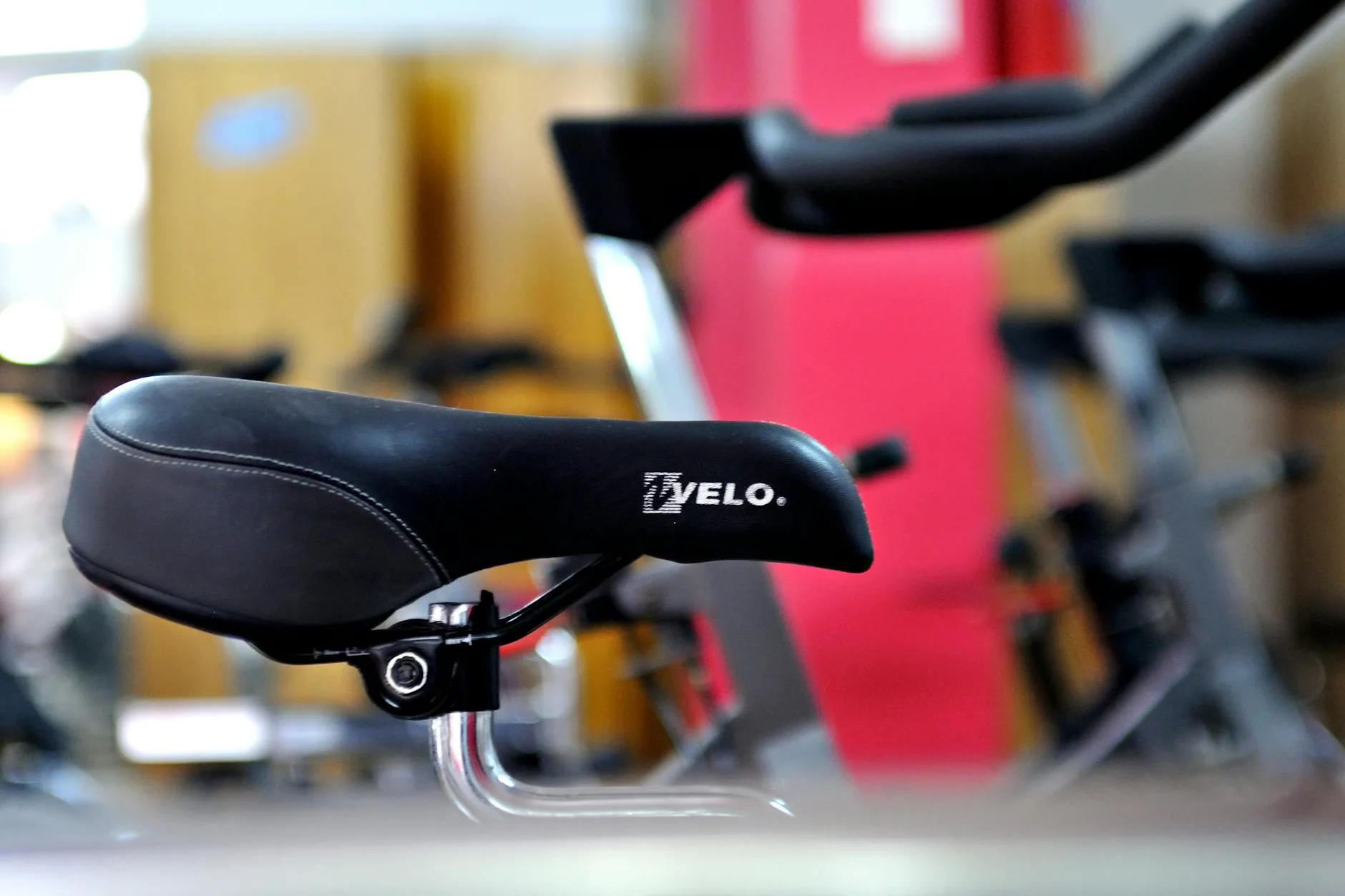
The Saddle Situation
Yes, the seat will be uncomfortable for the first week or two. This is normal and it does get better as your body adjusts. If it’s still painful after two weeks, invest in a gel seat cover (about £10-15 from Halfords or Amazon UK). Padded cycling shorts are another option, though most people training at home prefer to skip the lycra.
Understanding Resistance and Intensity
Before diving into the workouts, you need to understand how hard you should be working. There are three easy ways to gauge this.
Rate of Perceived Exertion (RPE)
The simplest method. On a scale of 1-10:
- RPE 1-3 — Easy. You could hold a full conversation without pausing
- RPE 4-6 — Moderate. You can talk but need to take breaths between sentences
- RPE 7-8 — Hard. Only a few words at a time
- RPE 9-10 — Maximum effort. You can’t speak at all
Most beginner workouts operate between RPE 4 and 7. Going above 8 regularly when you’re starting out is a fast track to burnout or injury.
Heart Rate Zones
If your bike has a heart rate monitor (or you wear a chest strap or fitness watch), you can train by heart rate zones. The British Heart Foundation has clear guidance on target heart rates during exercise, but the quick version is:
- Zone 1 (50-60% max HR) — Very light, warm-up territory
- Zone 2 (60-70% max HR) — Fat-burning zone, conversational pace
- Zone 3 (70-80% max HR) — Moderate effort, improving aerobic fitness
- Zone 4 (80-90% max HR) — Hard effort, building speed and power
- Zone 5 (90-100% max HR) — Maximum, sprint efforts only
Your estimated max heart rate is roughly 220 minus your age. So if you’re 35, that’s 185 bpm, and your Zone 2 would be 111-130 bpm.
Resistance Levels
Every bike uses different resistance scales. Some go 1-20, others 1-100. Don’t compare numbers between bikes — use RPE as your guide. What matters is that you can feel the difference between “easy pedalling” and “this is hard work.” If you can’t, you haven’t found the right resistance range yet.
Workout 1: The 20-Minute Steady State Ride
This is your bread-and-butter workout. Nothing fancy — just consistent pedalling at a moderate pace. It builds your aerobic base, teaches you to maintain a rhythm, and is the workout you’ll do most often in your first month.
The Workout
- Warm up for 3 minutes at low resistance, easy pedalling (RPE 3)
- Increase resistance to moderate and hold a steady pace for 15 minutes (RPE 5-6)
- Cool down for 2 minutes at low resistance, slowing gradually (RPE 2-3)
What to Aim For
- Cadence: 70-85 RPM (revolutions per minute). Most bike displays show this. If yours doesn’t, aim for a pace where you’re pedalling smoothly without bouncing in the saddle
- Heart rate: Zone 2-3 throughout the main block
- The test: Can you hold a conversation (with occasional pauses for breath) throughout? If yes, you’re in the right zone. If you’re gasping, reduce the resistance
Progression
Once 15 minutes feels manageable, extend to 20 minutes, then 25. When you can comfortably ride for 30 minutes at RPE 5-6 without wanting to stop, you’ve built a solid aerobic base.
Workout 2: The Interval Builder
Intervals are where things get interesting. Short bursts of harder effort followed by recovery periods. This is the workout that improves your fitness fastest, and it stops the “pedalling into infinity” boredom of steady-state rides.
The Workout
- Warm up for 3 minutes at easy pace (RPE 3)
- Push hard for 30 seconds — increase resistance and pedalling speed (RPE 7-8)
- Recover for 90 seconds at easy pace (RPE 3-4)
- Repeat the push/recover cycle 6 times
- Cool down for 3 minutes, gradually reducing effort (RPE 2-3)
Why Intervals Work
Your body adapts when it’s challenged. Steady-state rides are great for building a base, but intervals force your cardiovascular system to work harder and recover faster. After a few weeks of interval training, you’ll notice that what used to feel hard at RPE 7 now feels more like RPE 5. That’s your fitness improving.
Progression
- Week 1-2: 30 seconds hard / 90 seconds recovery × 6
- Week 3-4: 30 seconds hard / 60 seconds recovery × 8
- Week 5-6: 45 seconds hard / 60 seconds recovery × 8
- Week 7-8: 60 seconds hard / 60 seconds recovery × 8
The NHS recommends 150 minutes of moderate activity or 75 minutes of vigorous activity per week. Interval sessions count as vigorous, so two 25-minute sessions per week already ticks a good chunk of that box.
Workout 3: The Pyramid Climb
This workout simulates cycling up a hill that gets steeper, then levels off and descends. It’s excellent for building leg strength and teaches you to manage effort over a longer period.
The Workout
- Warm up for 3 minutes at easy pace (RPE 3)
- 2 minutes at moderate resistance (RPE 5)
- 2 minutes at increased resistance (RPE 6)
- 2 minutes at high resistance (RPE 7)
- 2 minutes at peak resistance — the summit (RPE 8)
- 2 minutes back to high resistance (RPE 7)
- 2 minutes at moderate resistance (RPE 6)
- 2 minutes at lower resistance (RPE 5)
- Cool down for 3 minutes (RPE 2-3)
Tips for the Climb
- Drop your cadence as resistance increases. At RPE 7-8, you might be pedalling at 55-65 RPM and that’s fine. It’s not a spin class — you’re building strength
- Engage your core. When the resistance gets heavy, there’s a temptation to lean on the handlebars. Fight it. Sit upright and use your legs
- The mental game matters. Knowing the second half gets easier makes the peak more manageable. That’s the beauty of pyramids — there’s always a downhill coming
Progression
Add 30 seconds to each tier every two weeks. Eventually you’ll be doing 3-4 minute blocks at each level, which makes for a seriously challenging 30+ minute ride.
Workout 4: The Endurance Builder
This one is longer, slower, and might feel boring at first. But it’s the workout that builds the aerobic engine everything else runs on. Think of it as laying foundations — not exciting, but essential.
The Workout
- Warm up for 5 minutes at easy pace (RPE 3)
- Ride at low-moderate resistance for 30-40 minutes (RPE 4-5)
- Cool down for 5 minutes, gradually slowing (RPE 2-3)
Making Long Rides Less Boring
Long steady rides are where most people reach for the phone or give up entirely. Here’s what I’ve found works:
- Watch something — a TV show, documentary, or YouTube video. Not scrolling your phone, though — that wrecks your posture
- Listen to a podcast or audiobook — my personal favourite. I’ve finished entire series on the bike
- Set distance targets — “I’ll ride 15km today” feels more tangible than “I’ll ride for 40 minutes”
- Music playlists — curate playlists where the beat matches your target cadence (around 75-80 BPM for Zone 2 riding)
When to Do This Workout
Once a week is plenty. This is your “easy day” ride that promotes recovery while still building fitness. It’s also the session where you should be able to breathe entirely through your nose — if you can’t, you’re going too hard.
Workout 5: The Tabata Sprint
This is the hardest workout in this guide, and it’s over in under 15 minutes. Tabata intervals are 20 seconds of absolute maximum effort followed by 10 seconds of rest, repeated 8 times. It’s brutal, effective, and over quickly.
The Workout
- Warm up for 5 minutes, gradually building effort (RPE 3 → 6)
- Sprint for 20 seconds — everything you’ve got, maximum resistance you can sustain (RPE 9-10)
- Rest for 10 seconds — stop pedalling completely or very slow spin
- Repeat the sprint/rest cycle 8 times (that’s 4 minutes total)
- Easy spin for 2 minutes
- Cool down for 3-4 minutes at gentle pace (RPE 2-3)
A Warning
Don’t do this workout in your first two weeks. Build a base with the steady state and interval workouts first. When you do try it, you’ll understand why it’s only once a week at most — the intensity is genuinely eye-opening. I remember my first Tabata session: I felt invincible for about three rounds, then the fourth round hit me like a wall. By round six I was making noises I didn’t know I could make. But the fitness gains are remarkable.
Who Is Tabata For?
Anyone who is short on time but wants maximum benefit. Four minutes of Tabata sprints gives you cardiovascular improvements that would take 30+ minutes of steady-state riding. The trade-off is that it’s deeply uncomfortable while you’re doing it. If you can build up to two Tabata sessions per week alongside your other rides, your fitness will improve faster than you’d believe.
How to Build a Weekly Exercise Bike Plan
Having individual workouts is useful, but knowing how to combine them into a weekly plan is what turns random sessions into actual progress. Here’s how to structure your week as a home gym workout plan.
Week 1-4: Foundation Phase
- Monday — Steady State (Workout 1) — 20 minutes
- Wednesday — Interval Builder (Workout 2) — 22 minutes
- Friday or Saturday — Steady State (Workout 1) — 20-25 minutes
Three sessions per week is plenty when you’re starting. Rest days are when your body actually adapts, so don’t skip them.
Week 5-8: Building Phase
- Monday — Steady State — 25-30 minutes
- Tuesday — Rest or light activity (walk, stretch)
- Wednesday — Interval Builder — 25 minutes
- Thursday — Rest
- Friday — Pyramid Climb (Workout 3) — 22 minutes
- Saturday — Endurance Builder (Workout 4) — 35-40 minutes
- Sunday — Rest
Week 9-12: Progressing Phase
- Monday — Interval Builder — 25 minutes
- Tuesday — Rest or active recovery
- Wednesday — Pyramid Climb — 25 minutes
- Thursday — Rest
- Friday — Tabata Sprint (Workout 5) — 15 minutes
- Saturday — Endurance Builder — 40-45 minutes
- Sunday — Rest
Listen to Your Body
These plans are guides, not gospels. If you feel knackered on a Wednesday and the thought of intervals makes you want to cry, do a steady-state ride instead. Or take a rest day and shift everything forward. Consistency over twelve weeks matters infinitely more than hitting every single session perfectly.
Common Mistakes Beginners Make on Exercise Bikes
Going Too Hard Too Soon
The number one mistake. You’re fired up, the bike’s new, and you hammer it for three days. Then you can barely walk on day four and the bike sits untouched for a fortnight. Start easier than you think you need to and build gradually. There’s no prize for destroying yourself in week one.
Ignoring Seat Setup
I covered this earlier but it’s worth repeating: a bad seat position causes knee pain, and knee pain makes people quit. Spend five minutes getting it right. Adjust it again after a week once you’ve got a feel for how the bike fits you.
Death Grip on the Handlebars
Your hands should rest lightly on the bars, not clutch them in a white-knuckle grip. Gripping too hard creates tension in your shoulders, arms, and neck. If you find yourself gripping hard, it usually means the resistance is too high and you’re using your arms to help push the pedals.
No Warm-Up
Jumping straight into high-resistance pedalling is asking for pulled muscles and achy joints. Even three minutes of easy spinning gets blood flowing, warms up the joints, and mentally prepares you for the session. Never skip it.
Comparing Yourself to Online Metrics
People in YouTube spin classes or Peloton sessions are often experienced cyclists. Watching someone maintain 100 RPM at high resistance and wondering why you can’t do the same is demoralising and pointless. You’re competing with yesterday’s version of yourself, nothing else.
Tracking Your Progress
Keeping a basic log of your workouts helps you see progress when it doesn’t feel like anything’s changing. It doesn’t need to be complicated.
What to Track
- Date and workout type
- Duration
- Average resistance level
- Average heart rate (if available)
- How it felt (RPE)
- Distance (if your bike displays it)
Simple Methods
- A notes app on your phone — one line per session
- A cheap notebook next to the bike
- A spreadsheet if you’re that way inclined
Progress Markers
After 4-6 weeks, review your log. You should notice:
- Lower heart rate at the same resistance level (your heart is more efficient)
- Lower RPE for the same workout (what felt hard now feels moderate)
- Greater distance in the same time period
- Longer sessions before fatigue sets in
If you’re not seeing these, you’re either not being consistent enough (aim for 3+ sessions per week) or you’re not challenging yourself sufficiently — time to bump up the resistance or add an interval session.
When to Move Beyond Beginner Workouts
You’ve been following the plans for two to three months, and things are feeling comfortable. The intervals that used to leave you gasping now feel manageable. The endurance rides that once felt endless now fly by. Here’s how to know it’s time to level up.
Signs You’re Ready
- You can complete the Tabata session without feeling like the world is ending
- Your resting heart rate has dropped noticeably
- You can hold RPE 6 for 30+ minutes comfortably
- The “hard” intervals no longer feel hard
What Comes Next
- Longer intervals — 2-3 minute hard efforts instead of 30-60 seconds
- Higher resistance — pushing into RPE 8-9 territory more regularly
- Structured training plans — periodised blocks with specific focus (endurance, power, speed)
- Cross-training — combining bike sessions with strength work, especially for legs and core
- Heart rate-based training — training by specific zones rather than RPE, using a chest strap for accuracy
The bike that felt intimidating in week one is now a tool you understand and enjoy. That’s the real goal — not some arbitrary fitness number, but a habit that sticks because it doesn’t feel like punishment.
Frequently Asked Questions
How long should a beginner exercise bike workout be? Start with 20 minutes including warm-up and cool-down. Most beginners can handle 15 minutes of actual pedalling effort comfortably. Build up gradually — adding 5 minutes every week or two — until you’re comfortably riding for 30-40 minutes. There’s no magic number, but consistency matters more than duration.
How many times a week should a beginner use an exercise bike? Three times per week is the sweet spot for beginners. This gives you enough frequency to build fitness while allowing proper recovery between sessions. As you get fitter over 6-8 weeks, you can add a fourth session. Avoid the temptation to ride every day at the start — rest days are when your body actually adapts and gets stronger.
What resistance level should I use on an exercise bike? It depends on your bike’s scale, but aim for a level where you can pedal comfortably at 70-85 RPM while still feeling like you’re working. You should be able to talk in short sentences. If you can sing along to your music, the resistance is too low. If you can barely get the pedals around, it’s too high. Use RPE 5-6 as your guide for most beginner workouts.
Will an exercise bike help me lose weight? An exercise bike burns roughly 300-500 calories per 30-minute session depending on intensity and body weight. Combined with a sensible diet, that contributes to weight loss. Interval workouts burn more calories per minute than steady-state rides, and they also boost your metabolism for hours after the session finishes. But exercise alone won’t overcome poor eating habits — the kitchen matters as much as the bike.
Is an exercise bike good for bad knees? Exercise bikes are one of the best cardio options for people with knee issues because they’re low-impact — your joints don’t absorb shock like they do when running. The smooth circular motion strengthens muscles around the knee without stressing the joint. Start with lower resistance and focus on higher cadence (80+ RPM) to minimise knee strain. If you have specific knee conditions, check with your GP before starting.