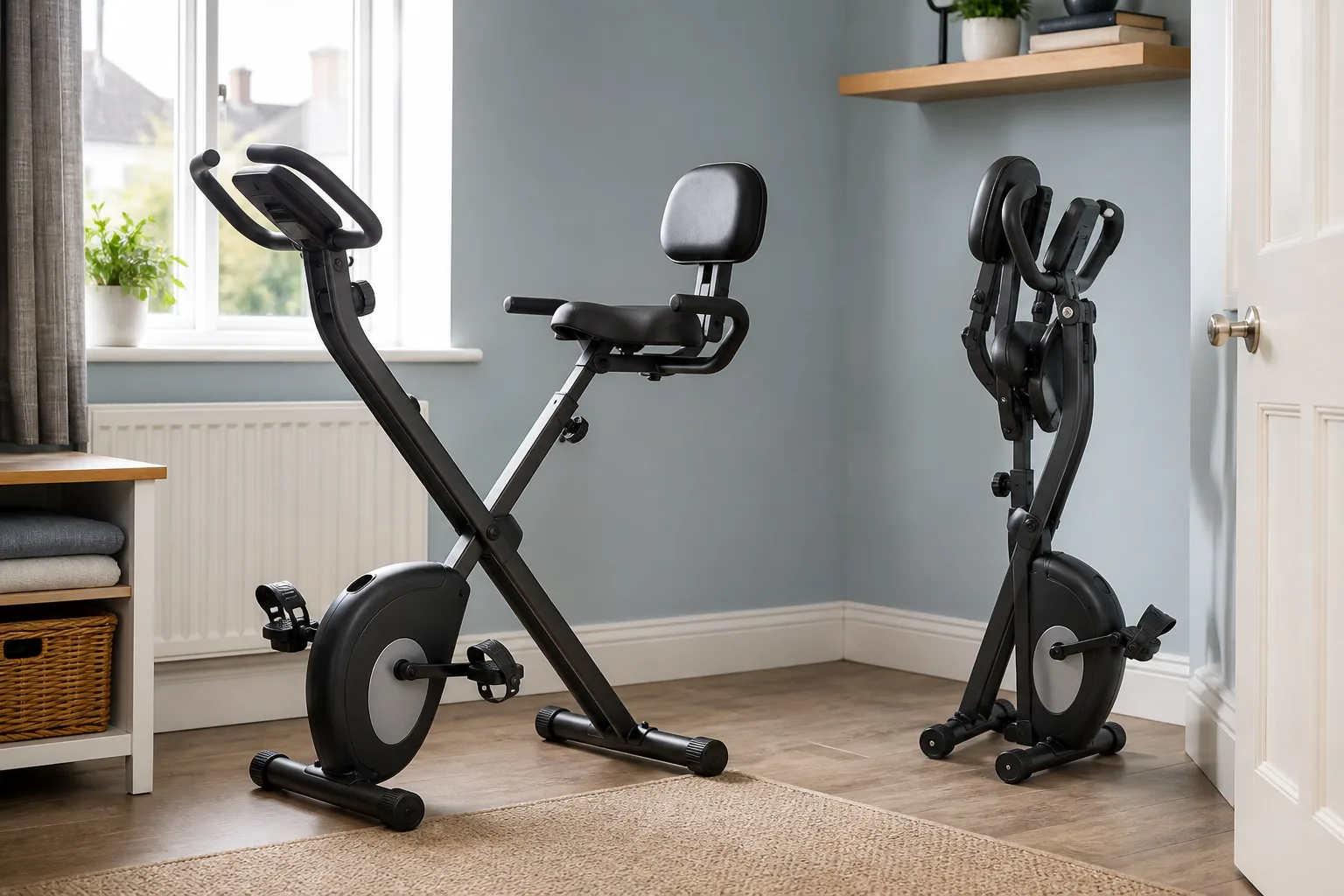
The best folding exercise bikes UK buyers can choose must feel stable in use and remain practical to move afterwards. The Phoenix Fitness 4-in-1 is our best overall choice because its 150kg stated capacity, 16 magnetic resistance levels, backrest and upright or semi-recumbent positions cover the widest range of households. Toputure adds app connectivity and a heavier flywheel, while MERACH, Ultrasport and XTERRA suit simpler fit, budget and storage priorities.
In This Article
- Best Folding Exercise Bikes UK: Quick Verdict
- Folding Exercise Bike Comparison
- How to Choose a Folding Exercise Bike
- The Five Best Folding Exercise Bikes Reviewed
- How Much Space Does a Folding Bike Really Save?
- Getting a Safe and Comfortable Riding Position
- Which Folding Exercise Bike Should You Buy?
- Frequently Asked Questions
Best Folding Exercise Bikes UK: Quick Verdict
Folding bikes are best for steady home cardio, warm-ups and low-impact sessions rather than out-of-saddle sprinting. Our beginner exercise-bike workouts show how to build sessions without relying on hard standing efforts. Their X-frame design is lighter and easier to store than a full upright bike, but usually has a smaller flywheel and fewer fit adjustments. Buy one for convenient, repeatable exercise—not because it promises to replace a commercial spin bike.
My shortlist
- Best overall: Phoenix Fitness 4-in-1 — the broadest combination of fit, supported seating and capacity.
- Best premium and app-connected: Toputure 5-in-1 — an 8kg flywheel, app support and a wide documented height range.
- Best for shorter riders: MERACH Folding Bike — documented for riders from 150–175cm and light enough to move easily.
- Best budget choice: Ultrasport F-Bike — a proven eight-level format without unnecessary extras.
- Best simple compact bike: XTERRA FB150 — clear dimensions and a compact folded floor footprint.
The shortlist separates five real buying decisions. A backrest can make steady sessions more comfortable, but it adds bulk. App support may keep training engaging, but it does not compensate for poor saddle fit or an unstable floor.
Folding Exercise Bike Comparison
| Model | Best for | Resistance | Fit / capacity | Main compromise |
|---|---|---|---|---|
| Phoenix Fitness 4-in-1 | Best overall | 16-level magnetic | 8 saddle positions; 150kg | About 20kg and bulkier than upright-only bikes |
| Toputure 5-in-1 | Best premium and app-connected | 16-level magnetic; 8kg flywheel | 150–190cm; 150kg | Feature-heavy and larger than basic X-bikes |
| MERACH Folding Bike | Best for shorter riders | 16-level magnetic | 150–175cm; 135kg | Limited published fit range |
| Ultrasport F-Bike | Best budget choice | 8-level magnetic | Up to about 129kg | No backrest or connected features |
| XTERRA FB150 | Best simple compact bike | 8-level magnetic | 147–178cm; about 102kg | Lowest capacity and an imported specification |
The table deliberately avoids a false “hardest workout” ranking. Resistance numbers are not standardised across brands: level 8 on one bike can feel lighter than level 5 on another. Frame fit and whether you will actually unfold the bike four times a week matter more.
How to Choose a Folding Exercise Bike
Start with rider fit, not features
A folding frame can put the saddle farther behind the pedals than a conventional upright bike. That is comfortable for some riders but can leave shorter legs reaching or taller riders feeling cramped. Look for a documented rider-height range, several secure saddle positions and enough clearance to pedal without your knees crowding the handlebars.
Our detailed exercise bike setup guide explains the position properly. As a quick test, your knee should retain a slight bend at the bottom of the pedal stroke and your hips should not rock from side to side.
Treat the maximum user weight as a limit, not a target
Choose a bike with headroom above the rider’s weight. The quoted number is a safety ceiling, not a promise that the frame will feel equally planted right up to it. A wider rear stabiliser, sensible machine weight and level floor all help. If you are close to a model’s limit, the 150kg-rated Phoenix or Toputure provides more published headroom than the lower-capacity XTERRA.
Measure it open and folded
Measure the usable exercise space, including room to mount and dismount, then measure the cupboard corner or wall space where it will live. XTERRA publishes an open footprint of roughly 81 × 46cm and a folded floor footprint of about 46 × 46cm. That is useful information; “space-saving” on its own is not.
For a wider planning check, see how much space you need for a home gym. Leave clear room around moving pedals and keep children and pets away while the bike is in use.
Magnetic resistance suits shared homes
All five choices use magnetic resistance. It is generally quieter and lower-maintenance than a friction pad, which helps when the bike is in a bedroom, living room or upstairs flat. Do not confuse quiet with silent: pedals, frame joints and the rider still create some noise, particularly on hard flooring.
Check the small ownership details
- Transport wheels: useful only if they meet the floor at a sensible angle when the bike is tilted.
- Folding lock: should locate positively rather than relying on the frame resting under its own weight.
- Pedal straps: help keep the foot centred but should release without a struggle.
- Console: time and cadence habits matter more than optimistic calorie estimates.
- Warranty and spares: especially important for a hinge, saddle clamp and resistance cable that will be moved repeatedly.
The Five Best Folding Exercise Bikes Reviewed
1. Phoenix Fitness 4-in-1 — Best overall

Phoenix is the most balanced choice for a household that wants more than a bare X-bike. It offers upright and semi-recumbent positions, a backrest, arm and leg resistance bands, 16 magnetic resistance levels and eight saddle-height positions. The stated 150kg capacity and adjustable feet give it useful headroom when correctly assembled on a level floor.
At roughly 20kg, this is not the lightest machine to move, and the backrest and bands create more parts to adjust than on Ultrasport. The LCD pulse and calorie figures are useful for comparing your own sessions, not medical or laboratory measurements.
- Buy it if: you want supported seating, broad adjustment and a high stated capacity.
- Skip it if: you need the lightest bike to carry upstairs after every session.
- Main compromise: the most versatile package here, but also one of the heavier and more complex.
2. Toputure 5-in-1 — Best premium and app-connected

Toputure is the feature-rich option. Its 8kg flywheel, 16 magnetic levels and support for Kinomap, Zwift and FitShow provide more training variety than a basic folding bike. Four frame angles, seven saddle positions and a stated 150–190cm rider range make its fit easier to assess before buying.
The app connection and touch display add complexity, and the bike still cannot reproduce the stiffness or geometry of a full-size spin bike. At about 19kg, it needs a clear route to storage rather than being carried casually around the house.
- Buy it if: interactive sessions and a wider resistance range will keep you using the bike.
- Skip it if: you want a simple console or the smallest, lightest folded object.
- Main compromise: the strongest training specification, with extra setup, size and electronics.
3. MERACH Folding Bike — Best for shorter riders

MERACH makes sense for shorter riders because it publishes a 150–175cm fit range rather than implying universal sizing. The 16-level magnetic system, four saddle positions, phone holder and 135kg stated limit cover steady home cardio, while the listed machine weight is under 9kg.
Anyone taller than 175cm should choose from a model with a confirmed taller fit range. A very light frame is easy to move but can feel less planted than Phoenix or Toputure, so use a level floor and keep seated during exercise.
- Buy it if: you are within the published height range and move the bike frequently.
- Skip it if: you are taller than 175cm or want a backrest and resistance bands.
- Main compromise: excellent portability, paired with a narrower documented rider range.
4. Ultrasport F-Bike — Best budget choice

Ultrasport is the sensible budget format: eight magnetic levels, an adjustable wide saddle, hand-pulse sensors and a familiar X-frame that folds quickly. Its stated capacity of roughly 129kg is stronger than many basic folding bikes, and the TÜV/GS certification is a useful construction signal.
There is no backrest, connected training or wide resistance scale. The upright geometry still needs checking against your leg length, and the calorie display is an estimate. It suits seated moderate cardio rather than hard standing efforts.
- Buy it if: you want a known folding-bike design with simple controls and a keen price.
- Skip it if: supported seating, app workouts or very fine resistance changes matter.
- Main compromise: good core function for the money, without the comfort and training extras.
5. XTERRA FB150 — Best simple compact bike
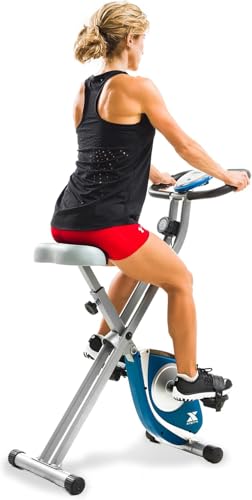
XTERRA is easy to understand. It has eight magnetic levels, a large seat, multi-position handlebars, pulse grips and a console for time, speed, distance, calories and pulse. Its folded floor footprint is about 46 × 46cm, making it practical beside a wardrobe or behind a door.
The stated fit range is about 147–178cm and the 102kg user limit is the lowest here. The Amazon UK model also uses imperial dimensions in its documentation, so convert and measure before ordering.
- Buy it if: you fit its published range and want a simple compact bike from an established fitness brand.
- Skip it if: you need higher capacity, a backrest or suitability above about 178cm.
- Main compromise: clear compact dimensions, but the tightest fit and capacity limits.
How Much Space Does a Folding Bike Really Save?
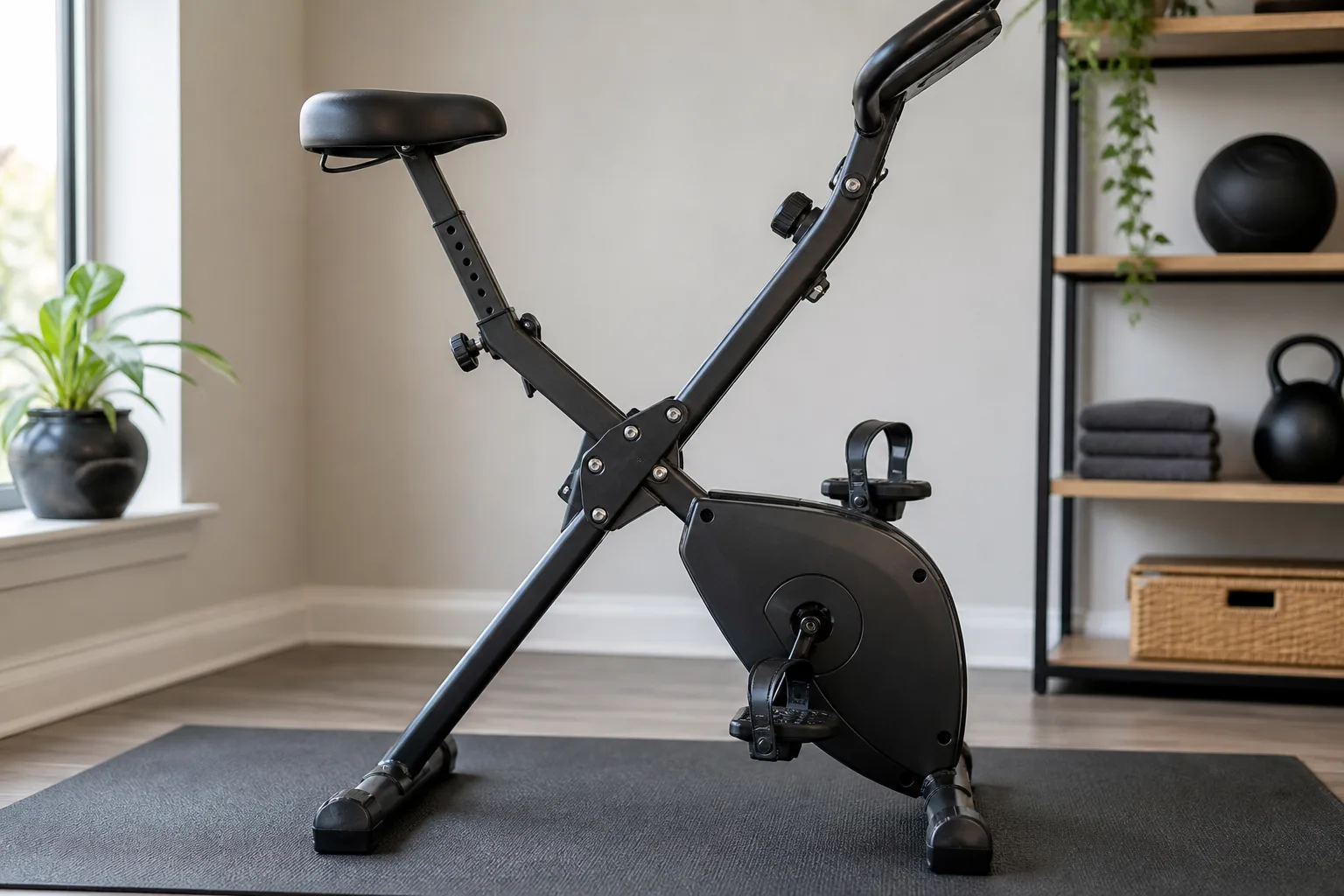
A folding bike reduces its floor footprint by bringing the two halves of the X-frame together. It does not become flat. The saddle, handlebars, pedals and resistance housing still create a tall, awkward object, so the best storage place is usually behind a door, beside a wardrobe or in a deep cupboard rather than under a bed.
Run a simple storage test
- Mark the open footprint: use masking tape on the floor and include space to get on safely.
- Mark the folded footprint: include pedal width and handlebar overhang, not only the frame dimensions.
- Walk the route: check door thresholds, tight corners and rugs between the exercise position and storage spot.
- Check the floor: a thin equipment mat can protect laminate and reduce small movements.
- Plan the routine: if folding and moving it takes several minutes, it may become a reason not to train.
A good folding bike is easier to live with than a full-size cardio machine, but if you have permanent floor space and want harder sessions, compare the broader choices in our best budget exercise bikes under £200. If you are still deciding between cardio formats, our treadmill, bike and rower comparison explains the space and training differences.
Getting a Safe and Comfortable Riding Position
Place the bike on a level surface and open the frame until its locking pin or mechanism is fully engaged. Tighten the saddle and handlebar clamps, check both pedals and make sure nothing rocks before mounting. The manufacturer’s limit and assembly instructions take priority over generic advice.
Set the saddle in three checks
- Leg extension: keep a small knee bend at the bottom rather than pointing the toes to reach.
- Hip stability: lower the saddle if your hips rock; raise it if the knee stays heavily bent.
- Knee tracking: the knee should follow the foot rather than collapsing sharply inward.
Start with low resistance for five minutes and make only one adjustment at a time. The NHS physical activity guidance recommends spreading activity through the week and including strengthening work as well as aerobic exercise. A folding bike can cover convenient cardio, but it is only one part of a balanced routine.
Pulse sensors and calorie counters on low-cost bikes are rough feedback tools. Use them to compare your own sessions rather than to diagnose fitness or chase an exact energy number. Stop if you feel faint, develop chest pain or experience unusual shortness of breath.
Which Folding Exercise Bike Should You Buy?
Buy the Phoenix Fitness 4-in-1 if you want one recommendation. Its supported and upright positions, 16 resistance levels and 150kg stated capacity make it the broadest household choice.
Choose the Toputure 5-in-1 for app-connected sessions and a heavier flywheel. MERACH suits riders within its published 150–175cm range who prioritise portability; Ultrasport is the uncomplicated budget option; and XTERRA suits buyers who fit its narrower limits and want clear compact dimensions.
The biggest mistake is buying from the folded photograph while ignoring riding fit. Measure the open exercise area and storage route, then check height range, user limit and saddle adjustment before comparing screens or resistance counts.
Frequently Asked Questions
Are folding exercise bikes any good? Yes, for convenient low-to-moderate home cardio. They are less suitable for powerful standing efforts or riders who need the adjustment and stability of a full-size bike.
What is the best folding exercise bike in the UK? The Phoenix Fitness 4-in-1 is our best overall choice because it combines supported and upright riding positions, 16 magnetic resistance levels and a stated 150kg user limit.
Can tall people use a folding exercise bike? Some can, but frame geometry varies. Check the exact rider-height guidance and confirm that the saddle allows a slight knee bend without hip rocking.
Are folding exercise bikes quiet? Magnetic models are generally quiet enough for shared homes, though pedals, joints and floor contact still create noise. A level floor and equipment mat help.
Can I lose weight using a folding exercise bike? Regular cycling can contribute to energy expenditure and fitness, but weight change depends on overall activity and diet. Consistency matters more than the console’s estimated calorie figure.
Should I buy a folding bike with a backrest? A backrest can improve comfort on steady rides, but increases bulk and does not fix poor saddle height. Choose it when support matters more than the smallest storage footprint.