The best skipping rope is not automatically the fastest or heaviest one. It is the rope whose feedback, cable and adjustment suit the way you train. The Titan Armour Adjustable Speed Rope is our best overall choice because its two cable options, aluminium handles and tool-free length adjustment cover beginners, HIIT sessions and faster double-under practice without forcing you into one narrow style.
Weighted ropes are better for slower strength-endurance work, while a beaded rope gives clearer timing feedback when you are learning. The six choices below cover those different jobs. We have kept fixed prices out because they change quickly; compare the design first, then check the current offer.
In This Article
- Best skipping ropes UK: our direct answer
- The best skipping ropes at a glance
- Our six skipping rope recommendations
- Speed, weighted and beaded ropes compared
- How to choose the right rope length
- Surface, space and training setup
- Skipping workouts for different levels
- The Bottom Line
- Frequently Asked Questions
Best Skipping Ropes UK: Our Direct Answer
Buy the Titan Armour Adjustable Speed Rope if you want one versatile rope. Its lighter and thicker cable choices let you learn with more feedback, then move towards faster work without replacing the handles. The self-locking adjustment is also less awkward than repeatedly loosening tiny screws.
Choose the Valour Strike Quadra-Flex if you specifically want weighted training. Its two rope weights and removable handle weights create four useful combinations, so you can increase resistance without jumping straight to a very heavy cable. The Elite Jumps beaded rope is the better learning tool because the beads make the rope easier to hear and feel through each rotation.
A thin speed cable is the wrong place to start if you cannot yet maintain a relaxed basic bounce. It gives little feedback and punishes poor timing. Likewise, a 1lb rope is not a sensible all-purpose choice for high-speed intervals or double-unders. Buy for the movement you will practise most.
The Best Skipping Ropes at a Glance
| Rope | Best for | Construction | Adjustment | Main compromise |
|---|---|---|---|---|
| Titan Armour Adjustable Speed Rope | Best overall | Two cable thicknesses | Self-locking | Not a true heavy-rope workout |
| Valour Strike Quadra-Flex | Best weighted set | 100g and 180g ropes; removable 135g handle weights | Multiple combinations | More parts to organise |
| Elite Jumps 1in Beaded Rope | Best for learning rhythm | Segmented beaded cord | Trim-to-fit | Not intended for maximum speed |
| PrimaFIT Pro | Best speed/weight hybrid | Steel cable; removable handle weights | Self-locking | Heavier handles change speed-rope feel |
| Blukar Speed Rope | Best budget option | 3m PVC-coated steel cable | Adjustable buckles | Foam handles and basic hardware |
| 1LB Heavy Jump Rope | Best for deliberate heavy work | 1lb weighted rope | Cut-to-fit | Too slow and tiring for speed skills |
The comparison is deliberately CTA-free so you can compare the ropes without buttons interrupting the decision. Each recommendation below has one linked product image and one price-check button after the trade-offs are clear.
Our Six Skipping Rope Recommendations
1. Titan Armour Adjustable Speed Rope — Best Overall

Titan Armour is the strongest all-rounder because it avoids the usual choice between a forgiving first rope and a very thin speed cable. The set includes two cable thicknesses, aluminium handles, ball-bearing rotation, a cable protector and a carry case. The thicker cable gives more feedback while you establish rhythm; the lighter one is the more natural choice when you start increasing cadence or practising double-unders.
The self-locking length system is particularly useful in a shared household because you can change the setup without cutting the cable or reaching for a screwdriver. The complete item is listed at roughly 240g, so this remains a speed-oriented rope rather than a heavy conditioning rope. The extra cable and accessories also mean there is more kit to keep together than with Blukar.
- Buy it if: you want one adaptable rope for basic bounce, intervals and faster skills.
- Skip it if: your priority is slow, high-resistance shoulder and grip work.
- Main compromise: versatility adds accessories, but neither cable replaces a purpose-built heavy rope.
2. Valour Strike Quadra-Flex — Best Weighted Set

The Quadra-Flex is a more thoughtful weighted setup than a rope that puts all its mass in one place. It includes a 100g 6mm rope and a 180g 8mm rope, plus removable 135g weights in the handles. That creates four combinations: light rope with light handles, either rope with weighted handles, or the thicker rope with the added handle mass.
This range lets you progress in smaller steps and decide whether you prefer weight in the moving rope or in your hands. Rope weight provides continuous rotational resistance; handle weight mainly increases what your forearms hold. Neither should be treated as a shortcut to strength or fat loss. Start with the lightest combination, keep sessions short and stop if your wrists or shoulders lose comfortable control.
- Buy it if: you want adjustable resistance rather than one permanently heavy setup.
- Skip it if: you mainly train quick double-unders or want the simplest rope possible.
- Main compromise: the four combinations are useful, but cable and handle parts need organising.
3. Elite Jumps 1in Beaded Rope — Best for Learning Rhythm

A beaded rope is underrated for learning. The segmented cord has enough presence to show where it is in the rotation, and the beads provide audible feedback as they contact the floor. That makes timing easier to diagnose than with an almost weightless steel cable. It also holds a wider arc, which helps beginners feel the relationship between wrist turn and jump.
Elite Jumps uses shatter-resistant 1in beads and 5in handles. The rope is adjusted by removing beads and trimming the cord, so measure twice before making a permanent cut. The listed fit is for users up to about 183cm; taller buyers should verify the current variant rather than assume it will be long enough. It will not spin like a competition speed rope, but that is not its job.
- Buy it if: you are learning basic bounce, rhythm, side swings or simple freestyle.
- Skip it if: the sole goal is maximum-speed double-unders.
- Main compromise: excellent feedback comes with more air resistance and a slower top speed.
4. PrimaFIT Pro — Best Speed/Weight Hybrid
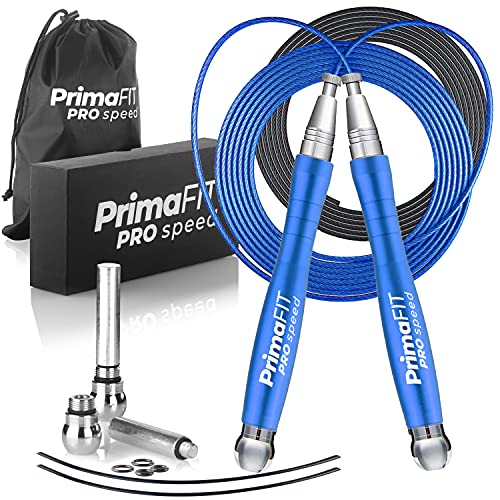
PrimaFIT combines a PVC-coated steel cable with removable weights inside aluminium handles. With the weights removed, it behaves more like a conventional bearing speed rope; fitted, the handles demand more from the forearms without turning the cable into a thick heavy rope. The self-locking length system can be adjusted without cutting, and the pack includes a spare cable, protectors for harder surfaces and a carry bag.
This is the better hybrid for somebody who likes a crisp steel-cable rotation but wants optional handle resistance. It is less convincing if you expect the full-body pull of a heavy cable: weight in the handles and weight in the rope do not feel the same. The published complete-item weight is about 500g, but that covers the set rather than proving the exact in-use configuration.
- Buy it if: you want speed-rope handling with removable resistance in the grips.
- Skip it if: you want a beaded learning rope or thick heavy cable.
- Main compromise: handle weights add load without providing the same rotational feedback as a weighted rope.
5. Blukar Speed Rope — Best Budget Option

Blukar covers the essentials at the budget end: a 3m PVC-coated steel cable, ball-bearing rotation, adjustment buckles and foam-covered handles. The slightly more substantial coated cable is easier to feel than an ultra-thin competition cable, which makes it a practical first purchase for home cardio and basic intervals. Spare adjustment buckles are included.
The trade-off is in the handle and adjustment design. Foam grips can absorb sweat and age less neatly than aluminium, while the buckles feel more basic than Titan Armour or PrimaFIT self-locking systems. Do not assume “tangle-free” means it can be stored in a tight knot; coil it loosely in the same direction after use. It is cheap enough to test whether skipping fits your routine without buying a complex set.
- Buy it if: you want a low-cost adjustable rope for basic home sessions.
- Skip it if: you already train fast double-unders or dislike foam grips.
- Main compromise: good core function, with less refined handles and adjustment.
6. 1LB Heavy Jump Rope — Best for Deliberate Heavy Work

This 1lb rope puts the resistance in the rope itself, creating a slower rotation that requires continuous control through the hands, forearms and shoulders. The 3m length can be cut to fit and the handles use bearings to reduce twisting. It suits short, deliberate conditioning rounds much better than fast skill work.
One pound is a meaningful jump from an ordinary speed rope. Beginners should not choose it simply because heavier sounds more effective. Use low jumps, relaxed shoulders and conservative intervals; fatigue that pulls the elbows wide or turns the movement into large arm circles is a cue to stop. The listing describes a cut-to-fit system, so the adjustment is less reversible than Titan Armour, PrimaFIT or Blukar.
- Buy it if: you already skip comfortably and want a rope-led resistance session.
- Skip it if: you are learning timing, have limited shoulder tolerance or want double-unders.
- Main compromise: strong rotational feedback at the cost of speed and easy progression.
Speed, Weighted and Beaded Ropes Compared
Choose a Speed Rope for Cadence and Double-Unders
A speed rope uses a light coated-steel cable and low-friction handle rotation. It rewards small wrist movements and a low, economical jump. That makes it the right category for fast intervals and double-under practice, but the light cable gives little feedback at slow speed. Titan Armour is the easiest bridge into this category; PrimaFIT suits users who want removable handle weight; Blukar is the inexpensive starting point.
Choose a Weighted Rope for Controlled Resistance
A weighted rope slows the rotation and increases the effort required to keep it moving. Weight in the cable is easier to feel throughout the arc, while weighted handles load the grip without changing the cable in quite the same way. Valour Strike gives you both variables. The 1LB rope is more specialised and should follow, not precede, comfortable technique with a normal rope.
Choose a Beaded Rope for Feedback
The Elite Jumps rope is the clearest choice for rhythm and freestyle basics. Beads make the rope visible, audible and less prone to collapsing into an indistinct line. They also tolerate contact with the floor better than a bare wire cable, although any rope will wear faster on rough tarmac. It is a teaching tool first and a speed tool second.
For general conditioning, the NHS physical activity guidance for adults recommends a mix of aerobic activity and strengthening work. Skipping can contribute to vigorous aerobic minutes, but it should sit alongside rather than replace resistance training. Our beginner dumbbell routine covers that separate role.
How to Choose the Right Rope Length
Start Long, Then Shorten Carefully
Stand on the centre of the rope with one foot and pull the handles upwards. For a beginner, the handle ends reaching around the armpits is a useful starting point because the extra clearance is forgiving. As technique improves, many people shorten the rope so it clears the head and feet with less wasted movement. There is no single perfect ratio because handle length, posture and preferred skill all matter.
- Set an adjustable rope slightly longer than you expect to need.
- Try relaxed single bounces on a clear, flat surface.
- Shorten both sides evenly in small increments.
- Only cut excess cable after several sessions confirm the fit.
A rope that repeatedly slaps a long section of cable into the floor is probably too long or being turned with wide arms. A rope that catches your toes despite a controlled jump may be too short. Self-locking systems are useful while learning because they preserve the option to reverse the change. Cut-to-fit ropes require more caution.
Check Height Limits Before Buying
Most 3m adjustable ropes suit a broad range of adults, but product limits still matter. Elite Jumps states a fit up to about 183cm for this variant. If you are taller, look for a longer confirmed cord rather than relying on a generic “one size” claim. In shared homes, a non-cutting adjustment is worth prioritising because one permanent trim cannot serve two very different heights.
Surface, Space and Training Setup
Protect the Rope and Your Floor
Smooth rubber gym flooring or a purpose-made exercise mat is kinder to coated cables than rough paving. Concrete and tarmac abrade thin speed cables quickly. Thick carpet and long grass create drag, making timing inconsistent. A stable mat can also reduce marks on a wooden floor, but it must lie flat and should not creep under repeated landings. Our guide to choosing mat thickness and grip explains why a soft, stretchy yoga mat is not always ideal for faster footwork.
Allow Clearance Around the Rope
Check the full arc before starting: ceiling lights, shelves, televisions and people walking behind you are all hazards. A standard 3m rope needs more room than its stored size suggests. Taller users or anyone practising higher jumps may be better in a garage or outdoors. If you are planning several pieces of equipment, our home-gym space guide helps map safe working zones.
- Footwear: use secure training shoes with a stable sole rather than loose slippers or socks.
- Warm-up: begin with ankle movement, calf raises and easy practice turns before fast intervals.
- Technique: keep jumps low, elbows near the ribs and rotation mainly in the wrists.
- Progression: add time, speed or resistance one at a time.
Skipping involves repeated impacts and rapid loading. Build volume gradually, particularly if your calves or Achilles tendons are not used to jumping. Our warm-up guide has useful general principles, though skipping-specific preparation should stay light and movement-led.

Skipping Workouts for Different Levels
Beginner Rhythm Session
Use a beaded rope or the thicker Titan Armour cable. Complete ten rounds of 20 seconds of relaxed basic bounce followed by 40 seconds of rest. The goal is not exhaustion; it is ten repeatable starts with quiet landings and a rope that passes cleanly under the feet. If continuous bouncing is difficult, practise a single jump, pause and reset.
Intermediate Cardio Intervals
Use a comfortable speed rope for eight rounds of 30 seconds of skipping and 30 seconds of rest. Alternate basic bounce and an easy boxer step if both are already controlled. Keep enough reserve to maintain posture through the final round. For broader programming ideas, see our home-gym workout planning guide.
Weighted-Rope Strength-Endurance
Start with the lightest Valour Strike configuration for six rounds of 20 seconds of work and 60 seconds of rest. Keep the pace deliberate. Do not combine a sudden increase in rope weight with longer intervals in the same session. The 1LB rope should be reserved for users who can already maintain control with a lighter weighted setup.
Double-Under Practice
Use Titan Armour’s lighter cable or PrimaFIT without handle weights. Practise small sets of single-single-double rather than repeated maximum attempts. A higher jump creates time for two cable passes, but the hands still need to stay low and close to the body. Stop when fatigue makes the jump or wrist action inconsistent; skill practice deteriorates quickly when every attempt becomes a sprint.
The Bottom Line
The Titan Armour Adjustable Speed Rope is the best skipping rope for most UK buyers because it offers two useful cable feels, durable aluminium handles and reversible adjustment. It is the safest one-rope recommendation for somebody moving from basic bounce towards faster intervals.
Choose Valour Strike Quadra-Flex for adjustable weighted training, Elite Jumps for rhythm and beginner feedback, PrimaFIT Pro for a speed cable with removable handle load, or Blukar for a low-cost start. The 1LB rope is the specialist choice for experienced users who deliberately want heavy rotational resistance.
The biggest buying mistake is choosing by claimed workout intensity instead of rope behaviour. Match the rope to your present skill, confirm the length can be adjusted for your height, and use a surface that will not chew through the cable.
Frequently Asked Questions
Is a Speed or Weighted Rope Better for Beginners?
Neither extreme is ideal. A moderately weighted PVC or beaded rope usually gives clearer feedback than a thin speed cable without demanding the shoulder control of a heavy rope. Elite Jumps is best for learning rhythm; Titan Armour with its thicker cable is the better route into speed work.
Can a Weighted Skipping Rope Build Muscle?
It can train muscular endurance in the grip, forearms and shoulders, but it is not a substitute for progressive resistance exercises. Treat weighted skipping as conditioning and use a separate strength plan if muscle or strength is the main goal.
How Long Should a Beginner Skip?
Start with short intervals totalling about three to five minutes of actual skipping, separated by generous rests. Add time gradually only when your calves, feet and technique recover comfortably. Continuous duration is less important than controlled, repeatable movement.
Can You Use a Speed Rope on Concrete?
You can, but rough concrete will wear a thin coated-steel cable faster. A smooth rubber surface or suitable mat protects the cable and provides more consistent contact. Outdoor protectors help, but they do not make a cable immune to abrasion.
Do You Need to Cut an Adjustable Skipping Rope?
It depends on the mechanism. Titan Armour and PrimaFIT use reversible self-locking adjustment, while the Elite Jumps and 1LB ropes may require trimming after the correct length is confirmed. Never cut on the first fitting; test the rope over several sessions first.
Which Rope Is Best for Double-Unders?
A light bearing speed rope is the right category. Titan Armour’s thinner cable is the best all-round choice here, while PrimaFIT without its handle weights is another option. A beaded or 1lb rope provides too much drag for efficient repeated double-unders.